
The barriers to entry in mature industries like Telecommunications, Automotive, and Energy have traditionally been high, and have required industrial levels of capital, logistics, and organisation to compete effectively, keeping the playing field and the supply chain rather exclusive.
Software changes everything
When the “softwarisation” trend hits a vertical industry, the incumbents, despite being often giants with large know-how pools and financial resources, have to face the same disruption risks that hit the tech sector. Since software is extremely adaptable, has initial design and implementation cost but near-zero marginal production cost, and can be distributed worldwide very cheaply and extremely fast, it is the perfect enabler of decentralised, community-based, and highly adaptable innovation approaches. This is especially true when suitable legal and organisational frameworks like Open Source Software are available for immediate adoption.
During a softwarisation transition, industrial sectors often exhibit a specific duality, which can be likened to one of the foundational narratives of Open Source Software itself, The Cathedral and the Bazaar by Eric S. Raymond. Specifically, a split emerges between:
- Established Industrial Offers: Capital-intensive, structured, and top-down (Cathedrals).
- Community-Driven Alternatives: Bottom-up, open-source, and incredibly resilient (Bazaars).
The strategic challenge
In the European research landscape, we see distinct verticals—Telecoms, Cloud Software and Services, Manufacturing/Automotive — all facing this shift. Beyond these specific sectors, Open Source Software has been widely recognised in Europe by the European Commission and several other key associations and initiatives as a critical enabler of technical competitiveness, digital sovereignty, and economic prosperity. To compete globally (especially against the US and China), we cannot just rely on industrial planning and might. We must catalyse the combined power of the relevant “cathedrals” and “bazaars” in ways that echo complexity-oriented approaches to large scale management: not “crossing gaps” or “building bridges” between islands, but affecting both contexts (and their cross-context) through local, parallel, and mostly safe-to-fail actions that foster emergent combinations of industry and community outcomes.
Case study: the telco-cloud & computing continuum convergence
A crystal clear example of this friction is visible in the convergence of Telecommunications and the Cloud-Edge-IoT continuum and its relationship to Open Source and Standardisation, which was the topic of the latest SNS4SNS event this February and the previous one in November 2024. With some simplification, the duality described above can be recast in a more detailed way as follows:
- The “Cathedral” (Telco and Cloud Software from Operators and Equipment Vendors): This world operates on the SDO (Standard Development Organisation) ethos—think ETSI or 3GPP. It prioritizes rigorous control, global interoperability, and long-term stability (“The Golden Copy“). Its business and operation models often rely on patent-aware standards and needs to combine Open Source and FRAND (Fair, Reasonable, and Non-Discriminatory) licensing.
- The “Bazaar” (Community-driven Cloud Software and Services): This world operates much closer to the Open Source ethos. It prioritizes agility (“release early, release often”), rapid prototyping, and avoiding vendor lock-in. Its legal framework often relies on OSI-compliant licenses that are often fundamentally at odds with restrictive patent licensing.
As these sectors merge, we cannot simply force one licensing model onto the other. We need a synthesis where we retain the reliability of standards while adopting the speed of open source, operating according to dynamic and context-aware complexity management. This combination of targeted intervention on larger industrial efforts with a more scattered action to involve many diverse communities and projects of smaller size is well expressed in the latest (2025-2027) Horizon Europe funding in this area (see Figure below), combining the 6G Telco Cloud Enablers and 3CN Large Scale Pilot on the industry side, and the Open Internet Stack on the community side.
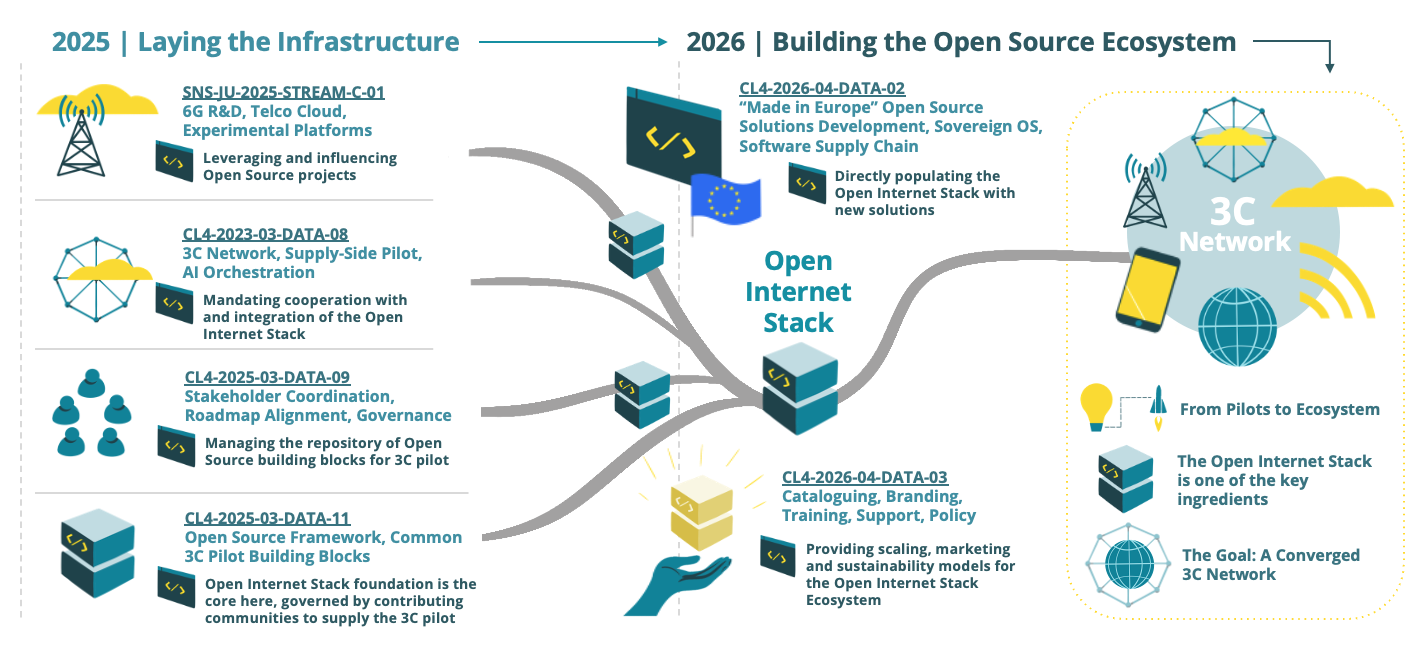
Such a combined funding strategy is set to be very effective and achieve impact greater than the sum of its parts, as long as all involved actors observe, make sense, and dynamically operate considering not only their own context but also the cross-context (what happens “on the other side” and on all close and related contexts), to spot weak signals and be ready to amplify and leverage them. If each part of this multi-stakeholder assembly only looks at their own narrow perspective, the overall impact, resilience, and ultimately success will be greatly diminished.
The role of agile mediation
For the reasons mentioned above, we need to embrace diversity and resilience. A key ingredient for this are mediating actors capable of diplomacy across the spectrum—connecting the more structured but dependable requirements of industry with the dynamic, unconstrained nature of Open Source communities. This is a general argument, but when considering the Horizon Europe R&I programme, these mediating actors are typically Coordination and Support Action (CSA) projects: these smaller initiatives, when properly managed by capable hands and positioned in their research and innovation environment, can be game changers exactly because of their agility and mediation capabilities.
Here is a somewhat counter-intuitive point worth highlighting: when the need is agile mediation, large procurement/tenders can suffer from having too much budget and a tight contractual scope, often including some form of confidentiality. Tender consortia will tend to tackle agile mediation challenges with their internal resources, throwing money and manpower at a problem while ignoring the outside world. CSAs on the other hand, with their leaner budgets, will actually be more effective. They are forced by design to engage externally, coordinate existing efforts, and build synergies rather than “solve” the “problem”.
To be effective and turn the innovation and business challenges arising from softwarisation in Telecommunications and other industries, we don’t just need more and better funding in the European Commission programmes; we also need a more diverse but connected ecosystem spanning research, industry, and communities, as well as smarter coordination mechanisms that respect the open source ethos and apply it with awareness and finesse.
Access the full presentation
These ideas were recently presented at the SNS4SNS event in February 2025, where the intersection of telecommunications, cloud computing, and open source innovation was examined in detail. The complete keynote presentation is now available for download.