What we showed in Malaga, and why the shift toward native AI requires a strict look at operational boundaries, network overhead, and the bridge to standardization
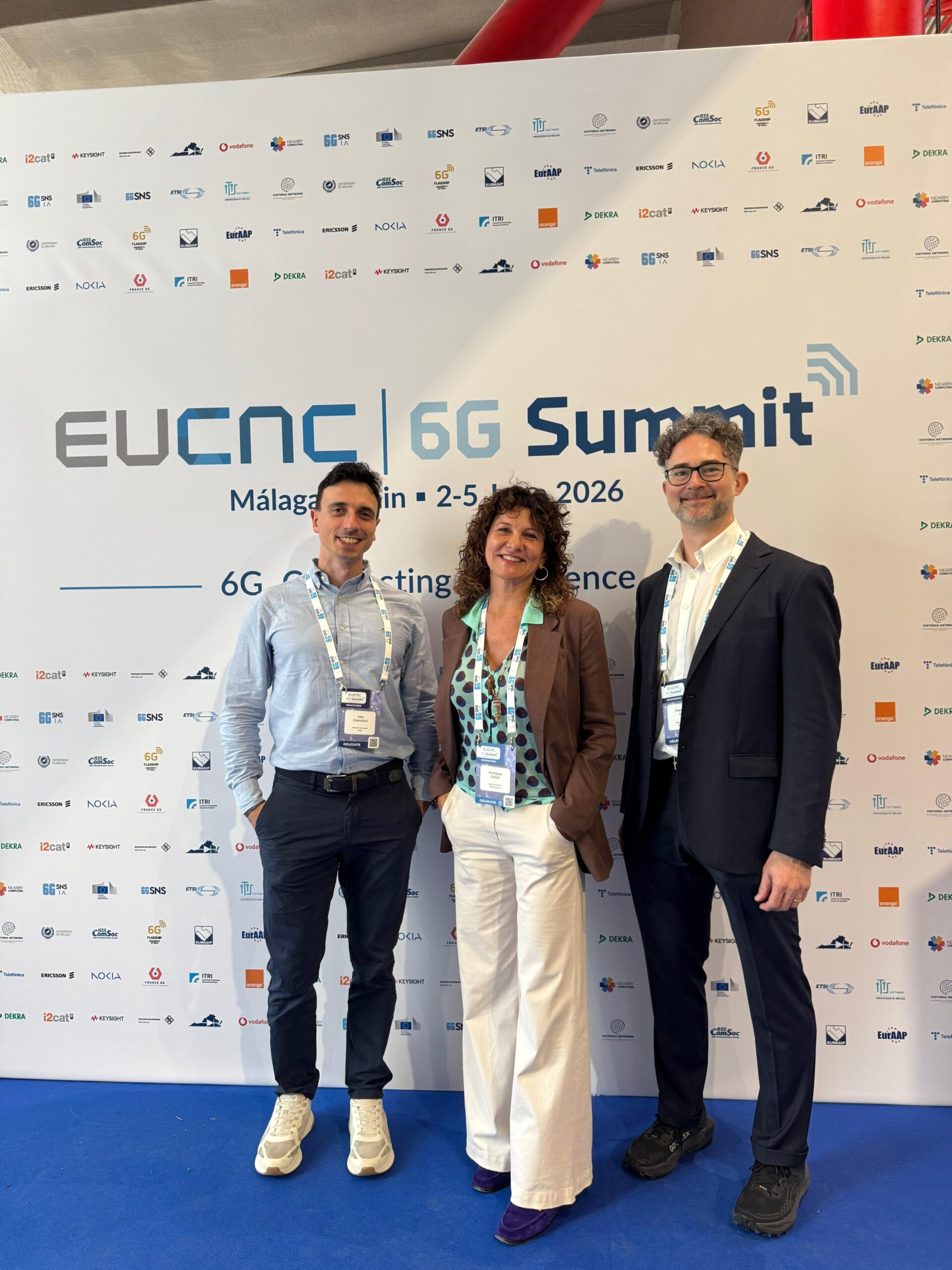
From 2 to 5 June, the telecommunications and digital research community gathered in Malaga for the 2026 EuCNC & 6G Summit. In its 35th edition, the event drew more than 1,100 delegates from over 40 countries through a dense programme of keynotes, papers, workshops and demonstrations. This year’s theme, “6G, Connecting Intelligence”, captured an industry-wide transition that has been building for years: the conversation has firmly moved from connecting devices to embedding intelligence natively into the network architecture itself.
The standard way to tell that story is as a step change. For much of the past decade, “AI for networks” meant optimisation: better scheduling, smarter handovers, incremental gains inside systems we already understood. What filled the rooms in Malaga, however, was a far more profound architectural paradigm: native AI integrated by design.
This structural shift introduces entirely new engineering implications. 6G networks will not simply use AI as an add-on service; they will host it as an internal structural component. This native integration changes the very nature of network traffic, generating massive internal communication overhead for agent-to-agent coordination, distributed inference, and continuous model synchronization across the cloud-edge continuum. The core question for the industry is no longer whether networks become AI-native, but how to manage this internal complexity while maintaining absolute carrier-grade reliability.
“The underlying engineering focus has matured,” says Dr. Massimo Neri, CTO of Martel. “A few years ago the bar was a model clever enough to optimise a system from the outside. Now, it is about deploying autonomous agents that can safely execute within the infrastructure under strict human-on-the-loop supervision. Building capable agents that remain observable, accountable, and subject to deterministic human overrides is where the real engineering challenge lies.”
AI-Native networks and the engineering challenge ahead
Several of the week’s core discussions reflected this shift, bridging long-standing architectural visions with newly mature technologies that make execution at scale possible. Proactive, intent-based orchestration was a primary example: software that accurately anticipates demand and dynamically allocates resources before bottlenecks form, rather than reacting after quality of service degrades.
Alongside orchestration, the cloud-edge continuum and its convergence with Terrestrial Networks (TN) and Non-Terrestrial Networks (NTN) held its place as a top strategic priority. Concurrently, Integrated Sensing and Communications (ISAC) rose sharply, reframing the network fabric itself as a distributed sensor rather than only a data carrier, a shift of immense relevance for satellite systems where Earth Observation can be actively coupled with ISAC-enabled SatComs. Sustainability also evolved from a high-level talking point into an explicit 6G design principle, raising the bar toward credible, system-level impact across environmental, economic, and social dimensions.
These are the precise operational layers where Martel Lab went to work.
Martel’s contributions through UNITY-6G
In UNITY-6G, a project co-funded by the SNS JU and SERI, Martel is researching agentic architectures for proactive workload orchestration. Vito Cianchini, AI and Data Science Developer at Martel, showcased this work in a dedicated workshop session and at the UNITY-6G booth, drawing strong engagement from industrial and academic partners.
Martel also contributed to an architectural vision paper titled “Advances on Unified Architecture for Open RAN-Enabled Distributed and Scalable 6G Networks,” presented during the conference.
Extending intelligence to Non-Terrestrial Networks
This same predictive approach is reaching into the high-stakes domain of non-terrestrial connectivity. Building on the foundational milestones of the recently completed 6G-NTN project, the upcoming 6G-NTN2 NEXUS flagship initiative was presented in a dedicated special session by Prof. Alessandro Vanelli Coralli.
Within NEXUS, Martel Lab takes on a prominent technical role, extending its agentic forecasting and orchestration frameworks to complex 3D space-air-ground routing topologies, ensuring that next-generation satellite networks can dynamically and proactively adapt to real-time traffic shifts and orbital dynamics.
EURO-3C and Europe’s telco cloud future
Martel also joined the presentation of EURO-3C, a major new European Telco Cloud initiative set to launch shortly. As a flagship effort to strengthen Europe’s sovereign, cloud-native foundations for next-generation connectivity, Martel Lab will leverage its deep expertise in monitoring, observability, and orchestration for 6G networks to support the core technical activities of the consortium.
Supporting SMEs and sustainable 6G development
Beyond direct technical research, Martel continued its work in structuring the collective voice of the European innovation ecosystem.
We co-prepared the Position Paper of the SME Working Group of NetworldEurope, “SMEs’ role in European Innovation,” previewed in a dedicated session to ensure the strategic priorities of smaller, agile technology providers are formally articulated into Europe’s 6G deployment agenda.
On sustainability, Martel leveraged its relevant expertise as coordinator of the recently completed SNS JU CSA project 6G4SOCIETY and was among the co-authors of the new technical report “Sustainable 6G by Design: An SNS-Driven Vision for AI-Native, System-Level Sustainability,” which details frameworks for engineering sustainability into 6G components from day one.
Bridging research and telecom standardization
Crucially, Martel recognizes that advanced research cannot mature in isolation; it must be systematically anchored in global telecom standards. Translating exploratory architectures into reproducible industry specifications is a core pillar of our strategy.
Building on our established collaboration tracks within bodies like ETSI, Martel is actively channeling technical insights from our SNS JU portfolio, specifically around zero-touch network management, cloud-native virtualization, and architectural security frameworks, directly into standardization channels, ensuring European research yields tangible market impact.
Building on decades ofresearch
This dual focus on forward-looking innovation and rigorous standardization brings the week back to a foundational perspective. It is an arena our CEO, Dr. Monique Calisti, has engaged with since the late 1990s at EPFL’s AI Lab, publishing early work on autonomous agents for network management, and later serving as a board member of FIPA to edit semantics and ontologies specifications.
The research of that period already mapped out multi-domain negotiation, self-optimizing routing, and zero-touch control. The very same milestones today’s SNS JU projects are driving toward.
“What has genuinely changed is real and powerful: compute availability that makes real-time inference feasible at the edge, open-source ecosystems that did not exist twenty-five years ago, and large language models capable of reasoning over network states,” says Dr. Monique Calisti, CEO of Martel Innovate. “What has not changed is the hardest engineering problem. Distributed agents built on disparate foundation models do not inherently share a reliable ontology; they rely on statistical approximations of language. While that is sufficient for a chatbot, it introduces unacceptable risks in critical telecom infrastructure. The gap between an elegant research paper and a trusted, field-deployed system remains wide. The SNS JU represents Europe’s best mechanism for closing it, and our role is to ensure we are building on a continuous, generational foundation rather than starting from zero.”
Looking Ahead
As 6G transitions from exploratory research toward concrete proofs-of-concept and eventual deployment by the end of the decade, the core requirements around autonomy, trust, energy metrics, and European digital sovereignty will only intensify.
The work that truly matters sits in the gap between theory and execution, turning advanced concepts into resilient systems that can be explicitly trusted in production. That gap is where Martel operates.
If you are looking to shape the future of AI-native 6G infrastructure, drive next-generation standardization, or explore the architectural boundaries of verifiably safe and robust autonomous systems, let’s talk. Together with our partners across the European ecosystem, we are turning advanced research into the trusted foundation of tomorrow’s connectivity.