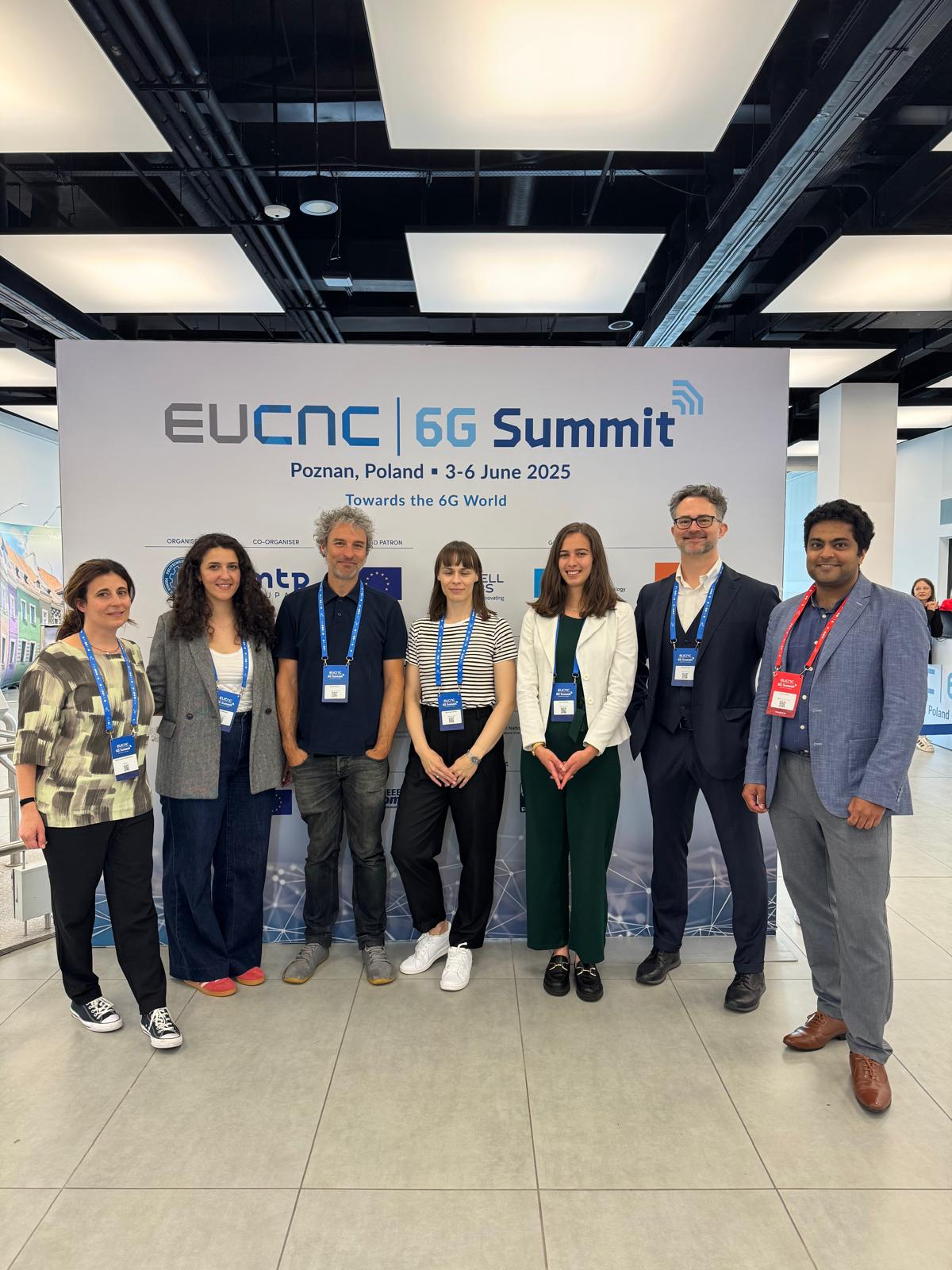
From June 3rd to 6th 2025, Martel took part in the EuCNC & 6G Summit, hosted this year in the vibrant city of Poznań, Poland. This annual event moves brings together hundreds of experts from various fields, including Telecommunications, Artificial Intelligence, Cybersecurity, Space, Business, Sustainability, and more. Our collegues from Martel Lab actively participated in tutorials, workshops and special sessions, contributing research insights, project results and fostering the advancement of European research in communication networks and 6G.
The key message that stood out during the event was:
We are entering the next phase of 6G: moving from pure research to proof of concepts and prototyping, paving the way for its expected rollout in 2030.
It is truly exciting to see how the crazy ideas of researchers* are becoming reality through collaborative efforts between industry and academia. * (“crazy ideas of researchers” is a quote from Erik Ström, professor at Chalmers University and one of the keynote speakers.)
Insights from attended tutorials and workshops
At Martel Lab, we are always keen to attend high-quality presentations to stay up to date with the latest research in 6G. One of the main topics of interest this year was 6G Non-Terrestrial Networks (NTN), particularly during the tutorial “NTN (r)evolution: stepping into 6G”, organized by Alessandro Vanelli-Coralli from the University of Bologna with presentations by Tomaso De Cola (German Aerospace Center (DLR), DE), Alessandro Guidotti (CNIT, IT), and Carla Amatetti (Univ. Bologna, IT). The session explored the potentiality but also the challenges of NTNs, including the complexity of orchestrating networks with continuously moving satellites and managing handovers with ground entities. These are not trivial issues and must not be underestimated. However, the tutorial also highlighted the significant advantages that NTNs bring. They are not limited to serving as a transport layer, but full integration with terrestrial networks is foreseen. In this vision, satellites will act as cloud and edge nodes, becoming an integral part of the overall infrastructure. Naturally, Artificial Intelligence plays a key role here. On the one hand, AI can enhance satellite capabilities, but on the other, it comes at a computational and energy cost, especially since satellites rely on solar power. Finding the right balance between optimal performance and energy efficiency will be crucial.
Given Martel Lab’s strong background in Artificial Intelligence, another tutorial that caught our attention focused on Explainable AI (XAI), titled “Explainable AI for Communications and Networking”. How can we design models that are complex enough to capture and recognize patterns in the data we analyze, yet simple enough to interpret and trust their decisions? Hatim Chergui (i2CAT Foundation, ES), Claudio Fiandrino (IMDEA Networks, ES), and Farhad Rezazadeh (Hostelworld Group, PT) tackled this question by presenting several methodologies for XAI, including SHAP, AIChronoLens, and LRP. These tools are remarkable in their ability to explain otherwise black-box models, such as deep neural networks. However, a key challenge highlighted during the session is that these methods often require expert knowledge to apply and interpret correctly. To address this, the use of Generative AI was proposed as a way to explain the outputs of highly complex models, including Large Language Models (LLMs) itself. This is a fascinating and somewhat recursive concept, opening up new possibilities for transparency and trust in AI systems.
Martel Lab contribution to EuCNC success
Martel Lab did not only attend engaging sessions, but also contributed actively to the conference, presenting results from several ongoing research projects
6G-NTN
For the 6G-NTN project, Alice Piemonti (Martel Lab) presented a paper titled “A Novel Framework for Proactive CNF Orchestration in 6G NTN”, with Martel as the first author. The paper focuses on the orchestration of Network Functions in cloud-native environments. In particular, it explores the use of machine learning to predict resource usage in Kubernetes-based systems. By forecasting CPU load, RAM usage, and application-level resource consumption of containers running network functions, the proposed approach enables proactive allocation of Kubernetes resources. The implementation of this framework is expected to significantly improve orchestration efficiency, reduce cold-start delays of Kubernetes containers, and minimize energy waste. These improvements are especially relevant in scenarios such as running network functions on satellites, where resources are limited and timing is critical.
HORSE
Alice also presented a poster showcasing the use of AI agents, particularly large language models (LLMs), to automate and enhance the cybersecurity of 6G networks. The poster illustrated how the HORSE framework can detect and mitigate cyberattacks without human intervention, using LLM agents to facilitate some processes. The scenario begins with attack detection, followed by automated selection of an appropriate mitigation strategy using a knowledge base enhanced with Generative AI. The final step involves enforcing the mitigation through Ansible Playbooks generated by LLMs. The presentation attracted strong interest from the audience, with many experts engaging to learn more about practical applications of LLMs in cybersecurity.
6G4SOCIETY
Martel’s CTO Massimo Neri co-moderated a Special Session on “Social Acceptance as a Catalyst for Sustainable 6G: Bridging Technology, Society, and Policy”, which explored the central role of social acceptance in shaping the development and deployment of 6G technologies, highlighting the risks of neglecting societal, political, and environmental dimensions as seen in the 5G rollout. Drawing from the 6G4Society project and other SNS JU initiatives, the discussion fostered the creation of a value-based, sustainable vision for 6G by integrating public concerns, governance, and shared societal values into technology design and evaluation. Massimo also participated in the panel discussion of a Workshop on “Technology Enablers for Sustainable 6G Design”, gathering experts from 17 SNS projects and key working groups to align on sustainability priorities for 6G, sharing insights, lessons learned, and strategies to embed environmental, economic, and social sustainability into future network design.
Eros4NRG
Last but not least, the Martel Lab presented the Eros4NRG project, developed by the Martel Dutch subsidiary within the framework of the NEMO research project, and showcased a live demo in one of the booths. The project focuses on managing and securely exchanging IoT data to support data-driven decision-making, using a modular platform that can be adapted to very different use cases. The Eros4NRG platform currently supports two use cases:
- Electric Vehicles: IoT sensors installed in electric vehicles collect data such as battery charge levels. This data is ingested by the platform, analyzed, cleaned, and used to visualize vehicle status in real time.
- Smart Buildings: Sensors installed in sustainable buildings track the difference between energy produced by solar panels and the building’s consumption. By considering time-of-day and seasonal patterns, the system forecasts energy trends and supports decisions on energy allocation and usage.
The role of Martel Lab in HORIZON EUROPE and SNS JU
The upcoming SNS R&I Work Programme 2025 positions Artificial Intelligence as a key driver for 6G networks. Generative AI, in particular, is expected to play an increasingly important role in automating tasks and enabling reconfigurable, adaptive network infrastructures.
Martel Lab, with a growing team of 10+ researchers, is actively contributing to these European priorities through its involvement in multiple SNS JU-funded projects. The Lab has produced several publications focused on applied AI for network orchestration and network security, reinforcing its commitment to advancing intelligent and secure 6G systems.
At Martel, we are well positioned to enhance the innovation potential of research projects and amplify their impact across the European and global technology landscape. If you are interested in collaborating on the application of AI technologies, let’s connect. Together, we can help shape the future of AI-native 6G networks in Europe.