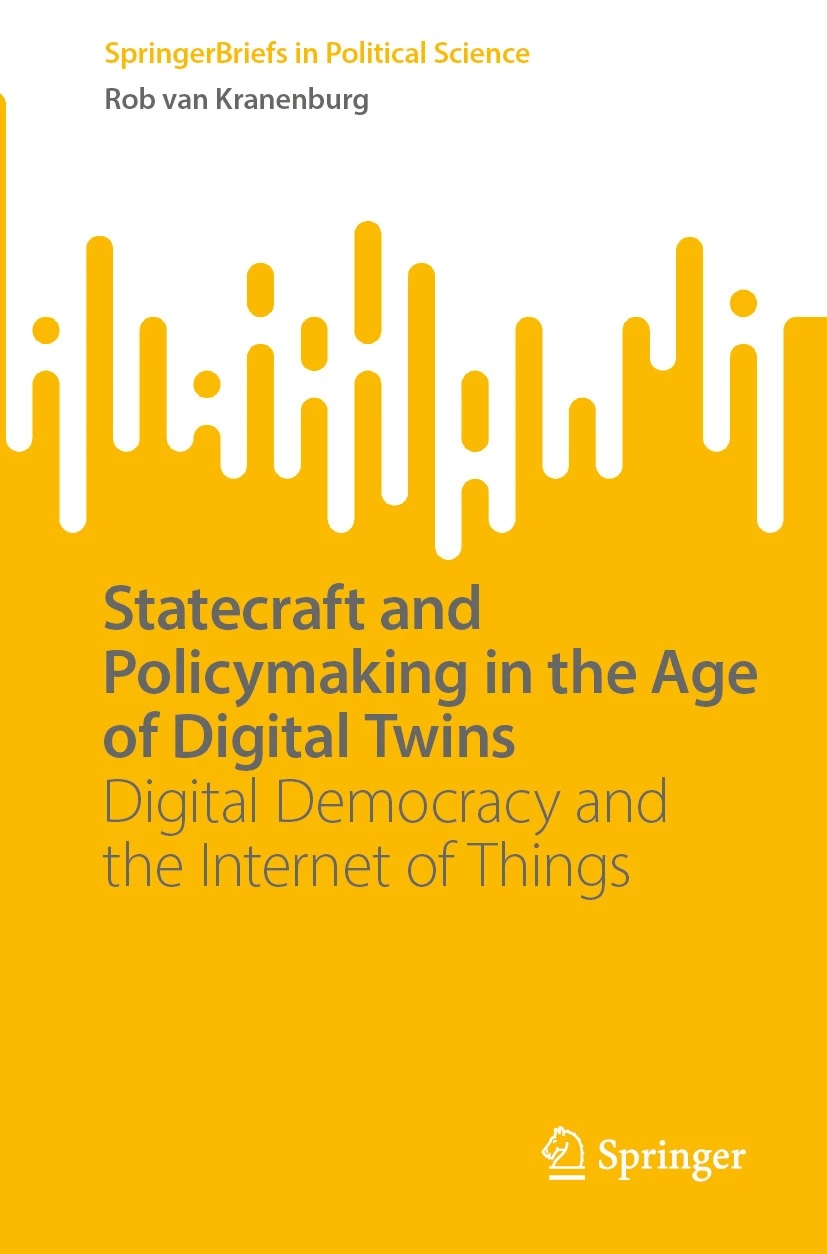
 Martel is pleased to highlight the latest book by our colleague Rob van Kranenburg: “Statecraft and Policymaking in the Age of Digital Twins: Digital Democracy and the Internet of Things”. This book explores the challenges and opportunities presented by digital transformation in Europe.
Rob examines how the transition from basic automation to the Internet of Things (IoT) is reshaping governance, decision-making, and policy frameworks. Drawing on empirical evidence from various industries and institutions, the book offers policy recommendations for strengthening Europe’s digital sovereignty.
One of the key concepts explored is the rise of digital twins – virtual representations of people, objects, and machines – that influence policy and industry. Rob argues that Europe must shape its own digital future by prioritizing sovereignty in infrastructure, hardware, and services.
“Citizens never had a chance to have a voice in the kind of connectivity that they want, because the technologies were so fast and invisible. The phone as we know it now could also have been a ‘Kenner’. That is a device described in a novel by Marge Pierce from 1976. She foresees a future in which people have such a tool. But there the value is shared, the feedback on (mental) health is positive and continuous, and data stays on the device. However hard it seems, we must rethink and rebuild our current architectures and use the Kenner – or a 6G phone – as a lever to regain control not only of the building blocks data, cloud, IoT, native AI – but of the domains: body, home, car, city as well. For that to happen we must tune our political system to a 21st century world.”
The book calls for the development of a next-generation internet designed specifically for European citizens, ensuring both regulatory control and innovation potential. Additionally, it presents the case for a European-built (6G) smartphone and hardware wallet, operating on its own OS, to strengthen technological integration across the continent.
Rob also compares Europe’s regulatory approach to the dominant models in the US and China. He highlights Europe’s reliance on legal frameworks, such as GDPR, to establish digital agency, while emphasizing the need for deeper engagement with emerging technologies.
The book also touches on the broader implications of AI, data governance, and connectivity, stressing the importance of designing policies that recognize the hybrid nature of digital and physical interactions.
“Statecraft and Policymaking in the Age of Digital Twins” is essential reading for policymakers, researchers, and professionals engaged in European digital governance and autonomy. It challenges current assumptions and proposes a bold framework for navigating the evolving technological landscape.
For those interested in the intersection of technology, politics, and policy, this book offers a valuable perspective on how Europe can assert its place in the digital future.