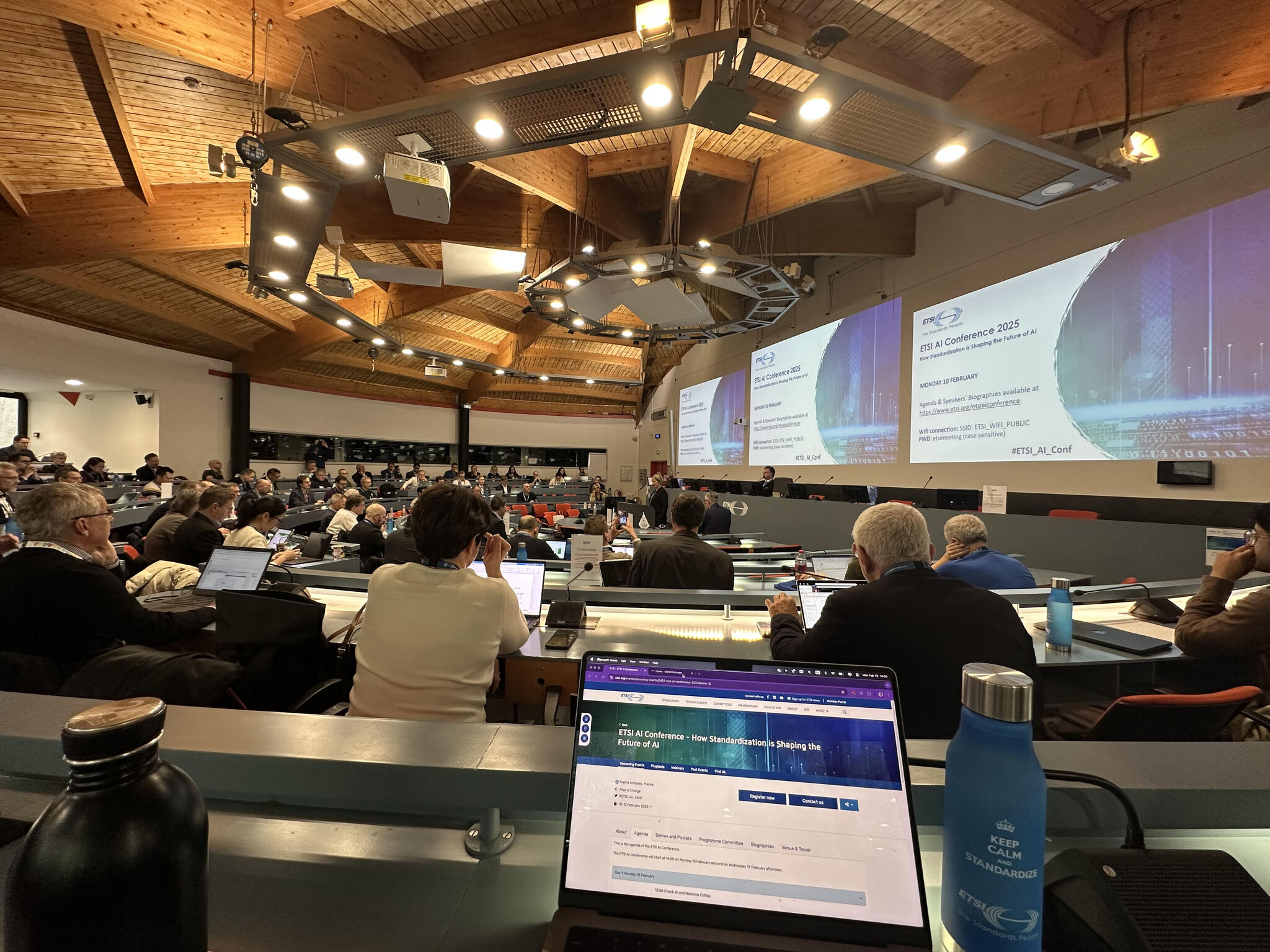
From 10 to 12 Feb 2025, Martel Lab participated in the ETSI AI Conference held at ETSI’s headquarters in Sophia Antipolis. As the name suggests, the conference focused on Artificial Intelligence (AI), particularly its role in standardization and regulatory activities, but also transforming businesses and society. This event brought together experts in Artificial Intelligence, as well as telecommunications, security, IoT, regulations, and standardization.
The discussions centered on AI’s capacity to transform industries, and in particular the Telco industry, by automating repetitive tasks, optimizing processes, reducing human error, increasing productivity, and lowering costs. AI enables the analysis of vast amounts of data to generate actionable insights and plays an increasingly crucial role in the development of new products, such as AI-powered autonomous vehicles. AI is not just an enabler but a catalyst for innovation and transformation across industries. The deep transformative potential of AI is being more and more embraced by key industry players and research institutions, and innovative AI-centered architectures based on intelligent agents are being proposed for standardization while being demonstrated in settings that are getting closer and closer to commercialization.
A key topic of discussion at the conference was indeed the AI Act, a fundamental cornerstone for ensuring safe and trustworthy AI in Europe. The Act introduces measures to guarantee safety, promote human-centric AI, and enhance trust in AI systems, especially those that pose risks to human health, safety, education, equity, and freedom. While the AI Act has been officially published and entered into force, Member States are now coordinating and setting out to implement the necessary procedures, including the designation of notifying authorities responsible for assessing the associated risks, specifically for the case of AI systems that fall under the “High risk” category. This is especially important given the August 2025 deadline for the full entry into force of the provisions.
AI is no longer a potential to explore – it’s on the verge of unleashing groundbreaking benefits across industries. Now, the focus is on regulation and trust, where ETSI and the EU at large are driving responsible innovation.
Massimo Neri, Martel’s CTO
THE ENVISIONED ROLE OF AI IN FUTURE NETWORKS
At the conference, numerous panelists and demonstrations highlighted the transformative potential of AI in 6G networks, positioning it as a key enabler for a range of objectives. These include bridging the digital divide by enhancing connectivity in underserved areas, simplifying network complexity through intelligent management, and improving security with advanced threat detection. AI is also seen as a driver for increasing automation, reducing the need for human intervention, and supporting more sustainable networks by optimizing resource use. Its proven strengths in data analytics and network optimization were underscored, particularly in solving complex models without analytical solutions and enabling predictive capabilities that enhance efficiency.
Beyond its technical applications, AI is opening new business avenues, such as more efficient space communication systems, low-power and cost-effective IoT solutions, and highly accurate positioning technologies. However, discussions also acknowledged challenges, such as the energy demands of large-scale AI deployment, the need for robust data privacy frameworks, and the complexity of integrating AI seamlessly across heterogeneous network environments.
A significant focus was the growing role of Large Language Models (LLMs) and Generative AI. The conversation is evolving from exploratory use to the native integration of LLM-based autonomous agents throughout network operations. These agents are envisioned to collaborate dynamically, enabling tailored network configurations and real-time deployments to meet fluctuating demands. While this promises greater adaptability and responsiveness, it also raises considerations around the reliability and governance of such autonomous systems in critical infrastructure.
Everybody in the sector is thrilled when new AI model series are released, but I am even more excited to see how these powerful systems will be integrated into future 6G networks to achieve unprecedented capabilities.
Alice Piemonti, AI Engineer and member of Martel’s Lab
AI IN SNS JU AND THE ROLE OF MARTEL
The upcoming SNS R&I Work Programme 2025 positions AI and ML as key drivers for the evolution of 6G networks, aiming to achieve full automation, enhance service provision, and support sustainable, secure, and disruptive applications. These technologies are intended to optimize network operations under energy and security constraints, enable intelligent telco cloud platforms, and position Europe as a leader in global standards. By integrating AI/ML across architectural, operational, and security domains, the programme seeks to deliver scalable, resilient, and innovative connectivity solutions tailored to vertical industries and societal needs.
Martel Lab, with a growing team of 10+ researchers, is actively contributing to these European objectives through research and development activities in multiple SNS JU-funded projects. More specifically, in the 6G-NTN project, Martel is developing an AI-driven component to forecast Kubernetes pod resource usage, enabling proactive orchestration of containerized network functions, while in the HORSE project, it leverages Generative AI to organize cybersecurity knowledge and build an intelligent database of cyberattacks and mitigation strategies. Additionally, in the newly launched UNITY-6G project, Martel is focusing on advancing AI algorithms for distributed systems and load forecasting to optimize network orchestration.
As Martel, we are positioned to play a significant role in increasing both the innovation potential of research projects and increasing their impact on the European and global ecosystem. If you’re interested in collaborating on the effective, secure and optimized application of AI technologies, let’s connect! Together, we can shape the future of responsible AI in Europe.