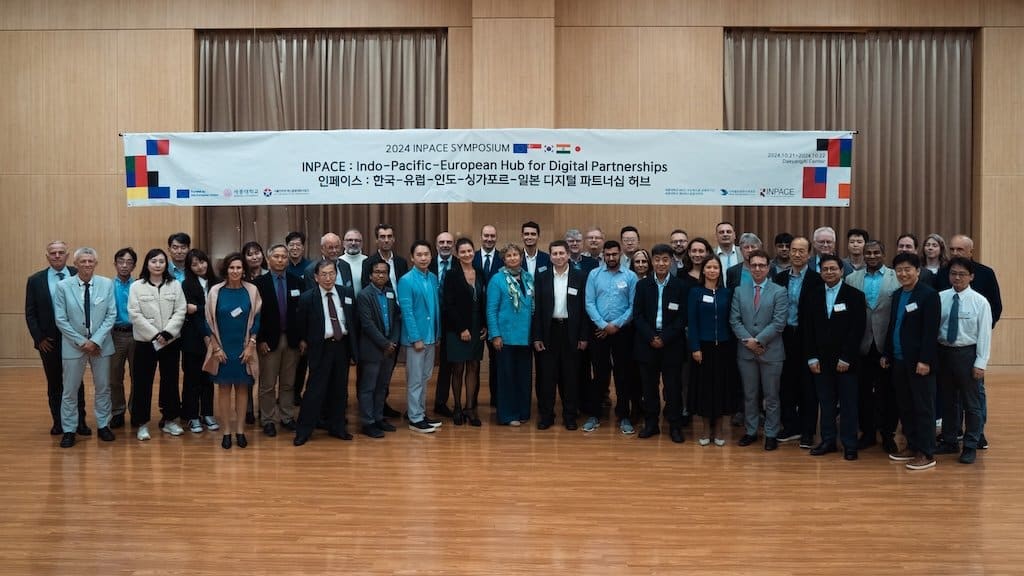
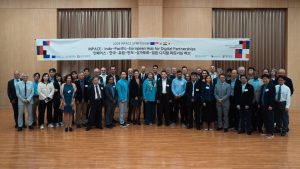
 In an important step toward strengthening digital cooperation between Europe and the Indo-Pacific region, international experts gathered in Seoul to explore the latest advancements in digital technologies and their transformative applications. Organised by the INPACE project, and hosted by Sejong University, the two-day symposium dedicated to Digital Technologies and Policies, laid the foundation in bridging technological innovations across continents, as the European Union deepens its digital partnerships with Japan, South Korea, Singapore, and India.
As an integral part of the INPACE consortium, Martel has taken the leadership on the specific topics of Cloud, Edge, IoT, Policies, and Digital Skills. Leading two Thematic Working Groups (TWG) – collaborative groups of experts from the EU and the Indo-Pacific that produce strategic outputs such as policy briefs and reports – Martel facilitated two workshops during the symposium. Additionally, at the 14th International Conference on ICT Convergence (ICTC) preceding the Seoul event, Martel’s CEO, Dr Monique Calisti participated in a panel discussion and presented the topic of smart and sustainable connectivity
Read more below about the main takeaways from the events and how Martel is expanding its work on digital technologies into the Indo-Pacific region, building on its extensive European expertise.
Digital Education and Skills in Europe and the Indo-Pacific
 In this session, participants explored the importance of digital skills in fostering effective digital partnerships between Europe and the Indo-Pacific. The discussions highlighted various innovative approaches and best practices from both regions in order to answer the key question of “How can digital education and skills support effective implementation of the digital partnerships?”.
The session opened by addressing the status of digital education and skills in regional partnerships. While this area has been deprioritized in the Digital Partnership between the European Union (EU) and Republic of Korea (ROK), countries like Singapore and India continue to emphasise its importance for advancing AI, cybersecurity, and data initiatives.
Participants highlighted the need for a continuous learning culture, beginning with early digital literacy education. Special attention was given to promoting female participation in digital education and addressing workforce transformation due to technological advancement (technological progress might replace certain jobs). Past and upcoming projects were discussed, including LEADS, which highlighted the need for advanced digital skills and the upcoming Skillaibility project, which aims to enhance workforce skills through AI.
Education emerged as a cross-cutting theme across all INPACE TWGs. This approach aligned with Japan’s vision for an egalitarian and human-centric education system. Notable Japanese initiatives include the Giga School program and collaborative virtual reality projects with Finland.
The session further highlighted several cybersecurity challenges. Small companies face difficulties in affording cybersecurity expertise. Several best practices were showcased during the session. Korea’s government-funded “Best of the Best” program, which trains future hackers was presented as a successful initiative. From the European side, the role of ENISA was presented, as a model in guiding cybersecurity education standards, with a call for adaptable programs that meet the digital transformation needs.
To sum up, the session underscored the cross-cutting nature of digital skills in achieving broader priorities. Looking ahead, the Republic of Korea’s upcoming status of Associated country in Horizon Europe from 2025 will open further opportunities for collaboration in digital education and skills development, such as co-developing education programs, conducting exchanges, collaborative research and talent-focused hackathons.
Policy: the EU’s Digital Partnerships in the Indo-Pacific
During the symposium, two sessions were hosted about policy, more specifically the EU’s Digital Partnerships in the Indo-Pacific. Speakers at both of these sessions, which aimed to bridge the gap between technologies and policies, examined the complex interplay between technologies and security, focusing on how to foster resilient partnerships amidst global challenges.
The discussion underscored the importance of balancing securitization with enabling technologies, particularly in terms of industrial competitiveness and cybersecurity, and noted the vulnerability of countries amid the dominance of the US and China, emphasising trust in partnerships. Resilient supply chains, partnership expansion, and the risks of technology weaponization were highlighted, along with concerns over discriminatory policies and declining research cooperation, pointing to the interconnectedness of AI, quantum tech, and energy consumption. The increasing focus of the EU delegation on digital issues and the need for a multilateral framework to address trust in data and infrastructure protection underscored the value of public-private cybersecurity collaboration. Quantum technologies’ transformative potential was discussed, with an international event planned in Geneva in November 2024 to explore security implications. Cooperation, selective partnerships, and cybersecurity capacity building were presented as essential, with success hinging on national commitment. The evolving EU-India relationship highlighted the challenges of differing worldviews on technological collaboration, advocating private sector involvement in data and technology discussions. The Korean government’s updated focus on cybersecurity and economic security in 2024 stressed effective communication and capacity building with partners.
The session underscored the urgent need for a cohesive strategy that balances security with innovation in the face of emerging technologies. Speakers emphasised the importance of trust, collaboration across sectors, and the necessity of addressing geopolitical challenges to create resilient supply chains and enhance international cooperation in technology through Digital Partnerships.
Cloud Edge IoT
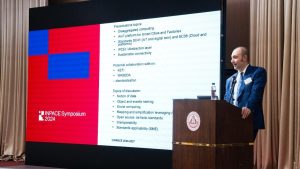 The central topic of Cloud Edge IoT was addressed in two different venues and workshops: as part of the special session on AI Data and enablers at the ICTC conference on 18 October on Jeju Island and during the INPACE Symposium on 21 October in Seoul.. The discussion covered several complementary topics on which Martel is already a front runner in Europe and facilitated new collaborations with partners from the whole Indo-Pacific region e.g. Korea Electronics Technology Institute (KETI), Korea Agency for Infrastucture Technology Advancement (KAIA), D-tonic, K-Water, Kookmin University (KMU), Sejong and Yonsei Universities and the Ministry of Science and ICT in ROK, Waseda University in Japan, the Indian Institute of Science and National University of Singapore.
In the area of advanced networking, discussions focused on several key topics: lessons learned from 5G implementation, planning for new 6G deployment, and novel concepts like disaggregated computing as enablers for innovative services. Novel IoT paradigms and their standardisation took a central part in the discussion. Participants emphasised the need to explore both de-facto and de-jure standards convergence, while ensuring standards remain applicable for SMEs and technologists. A crucial aspect of standardisation and interoperability centred on entity identification and labelling (e.g. ISO SC41 IoT and digital twin and ISO SC38 Cloud and platforms). he discussion highlighted how novel reasoning paradigms such as naming events and scope as part of named entities could lead to convergence in the way architectures, node, data can be made interoperable at a technical level. These discussions are relevant for Martel’s involvement in several technical project on Cloud, Edge, Data, IoT and AI (e.g. ACES, COGNETS, TEADAL) but also 6G (6G-NTN, HORSE). The lessons learned also serve as in the coordination and support actions such a s 6G4Society, NexusForum.eu, and SNS-OPS.
Another topic of discussion was the smart orchestrators and abstraction layers for the computing continuum, presented by OpenNebula, as part of the IPCEI initiative or the SIMPL framework promoted by the EC, with also a reference to Data Spaces and connectors for data sharing (e.g. FIWARE NGSI-LD).
Finally, Smart Cities were presented as an example of convergence of all the above technologies. Dr. Monique Calisti, CEO of Martel and president and founder of Digital for Planet the importance of sustainability as a driving factor in the digital transformation, calling for a novel development paradigm which is not only technologically driven but also multi-stakeholder and holistic, encompassing societal and environmental needs.
Martel, the Strategic Partner for Horizon Europe
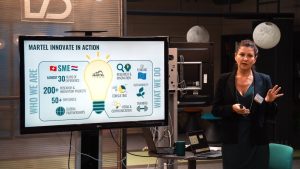 The Martel-lead TWGs will continue their work in the coming months, with the publication of a clear roadmap for future activities and a detailed public report of the outcomes of the symposium.
Martel will support Korean partners in successfully applying to the Horizon Europe program. This follows the Republic of Korea’s association with Horizon Europe, which will grant Korean organisations full beneficiary status for EU funding.
Key Events in 2025
INPACE has scheduled two significant events for 2025. The year will begin with the EU-Japan Week of Digital Technologies and Policies, running from March 31 to April 4. During this event, Martel will collaborate with NexusForum.EU and Indico Global to host workshops on Smart Communication, 6G, Data Spaces, and policy initiatives. Later in the year, Singapore will host the next Indo-Pacific Symposium on Digital Technologies and Policies.
These events will strengthen the ongoing dialogue between the Indo-Pacific region and Europe. Stay connected for updates and engagement opportunities. Follow us on social media and subscribe to our newsletter for the latest updates on digital innovation partnerships.