
Martel continues to broaden its horizons and extend its project portfolio to new strategic areas. One of the latest additions to our portfolio is BAG-INTEL: An intelligent system for improved efficiency and effectiveness of the customs control of passenger baggage from international flight arrivals, a 36-month Horizon Europe Research and Innovation Action in the domain of border security, which is set to run until August 2026.
Why – What – How
With the substantial growth of the volume of air travellers and limited human resources available, the border and customs authorities at inland border airports see the need for new tools that could increase the effectiveness and efficiency of baggage customs controls without the need to increase the total number of human resources involved in the process. BAG-INTEL was established to address this need – the project has committed to developing robust AI-based information utilization and decision-making support tools, which will help border and customs authorities at inland border airports perform their duties. The envisioned solution involves high-resolution cameras and robust AI, providing an end-to-end continuous reidentification of luggage. The BAG-INTEL solution ensures that all baggage is scanned and that suspicious luggage is kept track of so that the customs staff can easily find it to perform a manual inspection.
Context and operational scenario
The security scanning of outgoing luggage is quite well-developed but the customs scanning of incoming luggage is not full-fledged. Besides, the utilization of external data for luggage risk assessment is, in general, not exploited to its full potential for customs controls. Moreover, the state-of-the-art in reidentification of luggage has several disadvantages:
- Tags must be manually placed in/on the luggage and then removed before the traveller leaves the customs area following the manual inspection of their luggage so that they do not face another inspection the next time they travel with the same bag. While some airports apply radio-frequency identification (RFID) tagging for the customs reidentification of luggage, the RFID tags might damage the bag during their removal.
- The process mentioned above has a relatively high operation and maintenance cost, as it involves manual work; and an environmental impact due to production and immediate disposal of tags.
- Last but not least, the smugglers may notice and remove the tags before entering the customs area at the exit of the baggage delivery space, hindering the reidentification and capturing process.
How does BAG-INTEL come into play?
BAG-INTEL aims to enhance the effectiveness of the customs control of passenger baggage from international flight arrivals through the following features and capabilities:
- AI-powered functionality for enhanced detection of contraband in X-ray scanning of luggage,
- AI-powered risk assessment based on the analysis of external data (Passenger Name Records and Law Enforcement Agencies data),
- AI-camera-based end-to-end reidentification of luggage,
- Digital twin for system visualization and performance optimization.
The ‘BAG-INTEL system overview’ presented below illustrates the solution under development.
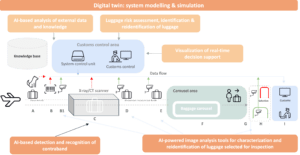
Upon flight arrival, when the luggage is unloaded and placed on the baggage conveyor belt, the customs risk of each piece of luggage is assessed using AI-supported tools under the supervision of the customs control officer(s). The applied risk indicators arise from 4 kinds of sensors/sources:
- The external data and knowledge, such as the Passenger Name Record (PNR) and the databases of Law Enforcement Agencies (LEAs), where suspicious travel patterns and links to organized crime are recorded. One example of using external data and knowledge is an illogical flight route (according to the PNR of the given passenger). Another, perhaps more obvious example, is the passenger’s connection to drugs-related crimes obtained through crossing their PNR with the LEAs’ data.
- An X-ray/CT scanner with absorption sensing and object recognition in the scanning image, which will be trained to detect/recognize various kinds of contraband, such as drugs, cigarettes, currency, etc.
- The customs control officer(s) who may detect suspicious content that has not been detected and flagged by the scanner itself.
- The dog handler input, if the customs apply a sniffer-dog track before the X-ray/CT scanner.
The risk indicator data from all sources is then fused to the overall risk assessment of the luggage; and based on the overall risk assessment of the luggage, a decision on whether the luggage is suitable for manual inspection is taken.
Who’s in?
24 partners from 8 European countries have come together to ensure a wide range of skills and technical knowledge needed to pursue the ambitious objectives of BAG-INTEL. Coordinated by Henrik Larsen (Legind Technologies, Denmark), the BAG-INTEL consortium is highly diverse and composed of industrial players, consultancy and advisory firms, universities and research organizations, ministries, customs and tax authorities, and civil authorities. Drawing upon the blend of our team’s scientific, project management, and communication backgrounds, Martel took on two roles within BAG-INTEL: supporting the Project Coordinator in project management tasks, such as coordination of budget and organization of project meetings; and the leadership of the communication and dissemination work package.
Recent activities: project presentation at the seminar in Brussels
On June 25-26, 2024, Henrik Larsen, the BAG-INTEL Project Coordinator and Martel’s Klaudia dos Santos, the project’s communication and dissemination lead, attended the Projects to Policy Seminar organized in Brussels, Belgium in the framework of the Community for European Research and Innovation for Security (CERIS). The event featured various informative sessions and panel discussions, covering several topics, including but not limited to communication, dissemination and exploitation in security research; EU Agencies’ Innovation Laboratories and research activities; the new EU AI Act and its effects on security R&I; the projects’ cooperation with national authorities and end-users; as well as several breakout sessions spanning different thematic areas, such as data management and the use of AI; surveillance, awareness, and threat detection; preparedness, society, and privacy; and innovative technological solutions. During the seminar, in addition to networking and exchanging expertise with peers, the participants had a chance to present their projects to experts representing EU agencies, including Europol, Frontex, CEPOL, eu-LISA, and EUDA. BAG-INTEL’s presentation was kicked off with a display of the newly released animated project overview video produced by Martel, followed by an introduction to the project’s operational scenario, its solution’s features and capabilities, and an explanation of how the project intends to advance beyond the state-of-the-art. The presentation generated significant interest among the participants leading to several follow-up discussions.
Recap
Summing up, the BAG-INTEL project intends to advance the customs control processes so that more contraband is detected and the cases of manual inspection, which do not lead to finding contraband decrease. The objective is to reduce false positives and only inspect the pieces of luggage containing contraband. Since the manual inspection will be focused on all, and only, suspect bags, more contraband will be captured without the need to involve extra human resources in the process. Moreover, the proposed AI-camera-based reidentification of luggage is non-intrusive, thus avoiding all the disadvantages of the currently used reidentification solutions.